Beyond the Pain: Unpacking the Fear of Movement
When we get injured, our immediate focus is almost always on the physical tissue. We ask: Is the muscle torn? Is the joint inflamed? How long until the ligament heals? But at Rivers RMT, we know that true recovery goes far deeper than anatomy. An injury doesn’t just impact your physical body, it changes how your brain perceives safety. Long after the physical tissue has repaired itself, a psychological and neurological shadow can remain, quietly dictating how you move. This month, we are stepping "beyond the pain" to look at the powerful connection between injury, the nervous system, and the fear of movement.
The Brain as a Protective Bodyguard
To understand why we protect healed injuries, we have to look at the role of pain. Pain is not a direct measurement of tissue damage; it is a warning system managed by your brain.
When you injure your lower back picking up an object, your brain files that specific movement away as "dangerous." Once the tissue heals, not matter how long that takes, the brain's memory of that pain remains. Out of a desire to protect you, your nervous system may continue to trigger a threat response (like sudden muscle bracing or an ache) whenever you attempt a similar movement.
In the clinical world, this is known as kinesiophobia: the fear of movement. It is a completely natural, survival-driven response, but if left unchecked, it can become the very thing that keeps you trapped in a cycle of chronic stiffness.
The Fear-Avoidance Loop
When a movement feels scary or uncomfortable, the most logical response is to avoid it. However, chronic avoidance creates a frustrating paradox:
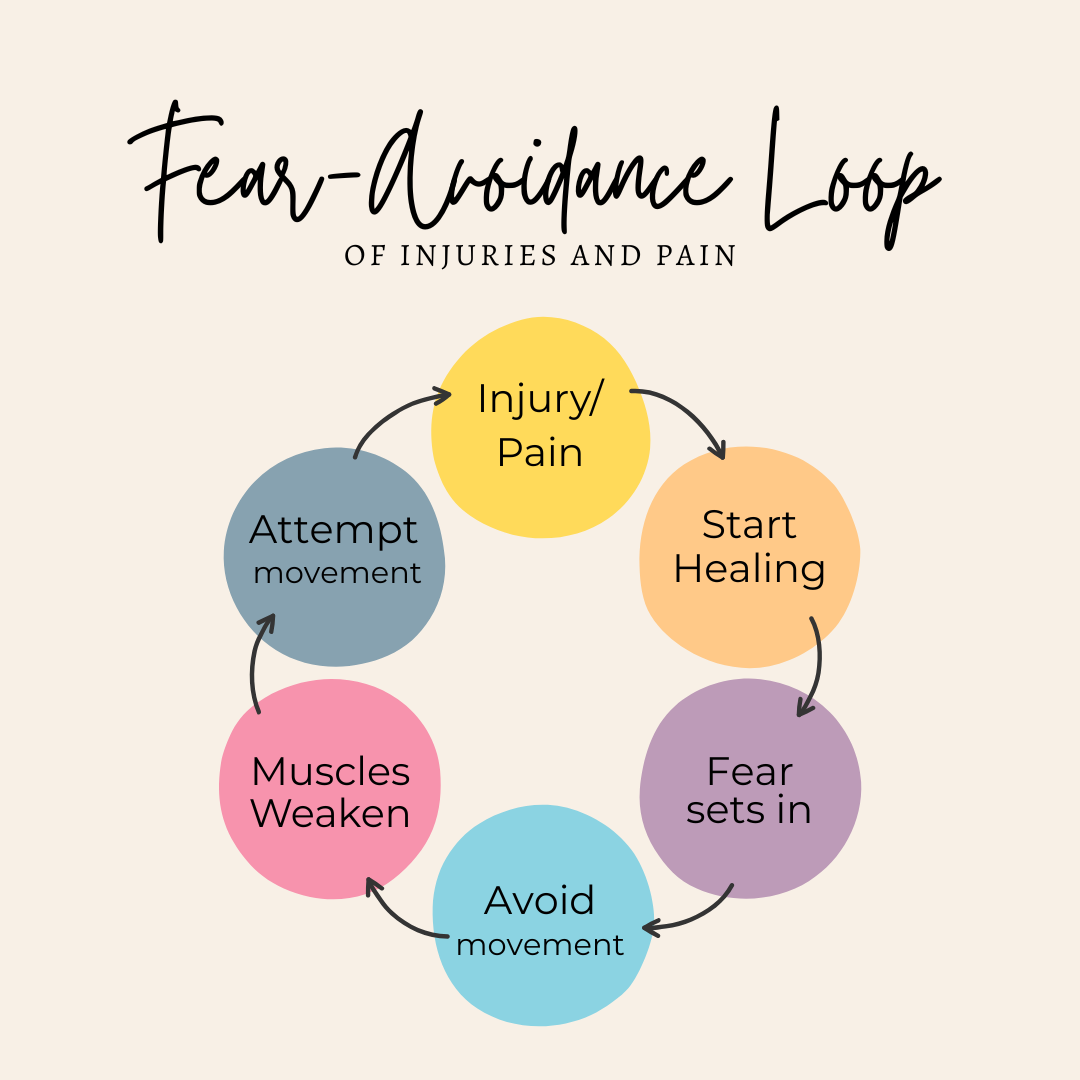
visual representation of the Fear-Avoidance Loop experienced after pain and/or injury
The Avoidance: You stop bending forward, twisting, squatting because your brain flags it as unsafe.
The Consequence: Because you no longer use that range of motion, the surrounding muscles weaken, and the joints become restricted and feel stiff.
The Result: The next time you “accidentally” make that movement, your body lacks the capacity to handle it, creating a minor strain. The brain sees this as absolute proof that the movement is dangerous, and the cycle tightens.
Moving past an injury isn't just about building physical strength. It is about teaching your nervous system that it is safe to move again.
Rewiring the System on the Treatment Table
This is where hands-on therapy plays a massive role that goes far beyond just "rubbing a tight muscle."
During a massage therapy session, we are providing your nervous system with safe, predictable, and non-threatening sensory input. When we gently work through a restricted or previously injured area while you are in a relaxed state, we are sending a powerful signal back to your brain: “Look, this tissue can be touched and moved, and it is perfectly safe.”
By down-regulating the sympathetic nervous system (your fight-or-flight response), we can temporarily lower the brain's guard. This opens up a vital window of opportunity where you can start moving that joint or muscle without the protective bracing getting in the way.
Moving with Confidence This Summer
If you have an old injury that still makes you hesitant to jump into summer sports, hike, or play on the floor with your kids, remember that your body is incredibly resilient. Your tissues have likely healed, now we just need to update your brain's software.
True recovery means reclaiming your freedom of movement without fear. Let’s use your next session to calm the nervous system, release the protective tension, and map out a gentle, progressive way to get you back to doing what you love.